Imagine a disaster scenario: roads are destroyed, infrastructure is crumbling, and people desperately need shelter. Instead of waiting days for rescue teams to arrive with heavy equipment, a fleet of intelligent drones swoops in, carrying building materials and the ability to construct shelters, repair bridges, and reinforce critical infrastructure on the spot. While this might sound like something out of a sci-fi movie, researchers at Carnegie Mellon University are turning it into reality.
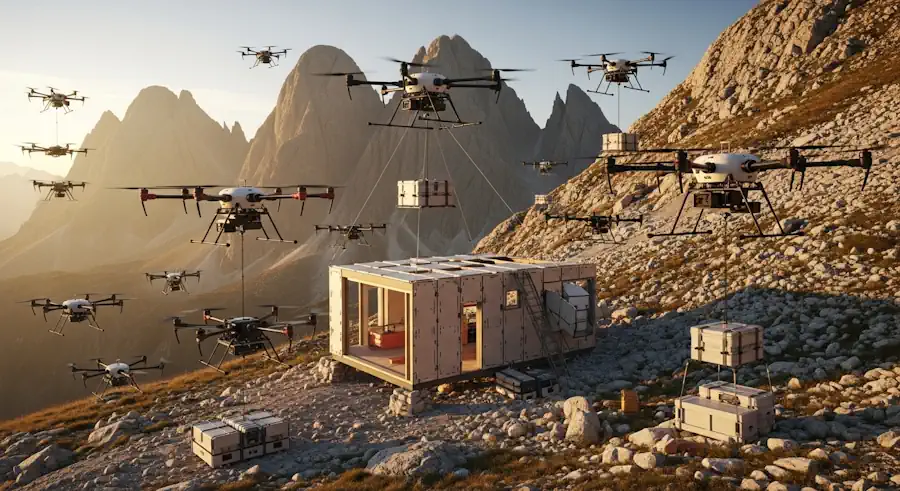
The team at CMU’s College of Engineering has developed a groundbreaking system that combines drones, 3D printing technology, and artificial intelligence to create what they call “aerial additive manufacturing.” In simpler terms, they’ve created flying construction workers that can build structures autonomously in hard-to-reach places.
The Challenge of Building While Flying
The concept of aerial additive manufacturing, essentially flying 3D printers, has intrigued researchers for years, but there’s a fundamental problem: drones are inherently unstable in flight. Traditional 3D printing relies on precise, layer-by-layer fabrication, which is nearly impossible when your printing platform is hovering in mid-air and constantly making micro-adjustments to stay aloft.
Amir Barati Farimani, an associate professor of mechanical engineering at CMU, approached this problem from a different angle. Instead of trying to make drones stable enough for traditional 3D printing, his team equipped them with magnetic blocks that allow for precise pick-and-place assembly. But the real innovation isn’t just in the hardware, it’s in the brain powering these aerial builders.
Teaching Drones to Think Like Construction Managers
The secret sauce in this system is a large language model (LLM), similar to the AI that powers chatbots and writing assistants, but trained to understand construction and spatial planning. This AI can translate high-level design goals like “build a bridge” into specific, executable instructions that the drones can follow.
“The adaptability of LLMs allows us to generate and adapt building plans onsite,” explained Barati Farimani. “If we encounter problems while building, we can switch gears to ensure efficient and accurate construction.”
This adaptability is crucial because, unlike controlled factory environments, real-world construction is messy. Blocks might be dropped in the wrong spot, gaps might appear, or the initial plan might prove inefficient once building begins. The LLM doesn’t just give up when these problems occur; it autonomously adjusts the plan and prompts the drone to work with the error rather than starting over from scratch.
Putting the System to the Test
To validate their approach, the Carnegie Mellon researchers designed two comprehensive sets of experiments. The first focused on testing the LLM’s creativity and ability to handle manufacturing errors. In contrast, the second examined how well the physical system could execute commands and adapt to problems in real-time.
For the quantitative testing phase, researchers created fifteen “constrained prompts”, design challenges with only one correct answer, on a 10×10 grid. This allowed them to precisely measure the AI’s accuracy using a metric called Intersection over Union (IoU). Each test was run five times to ensure consistent results.
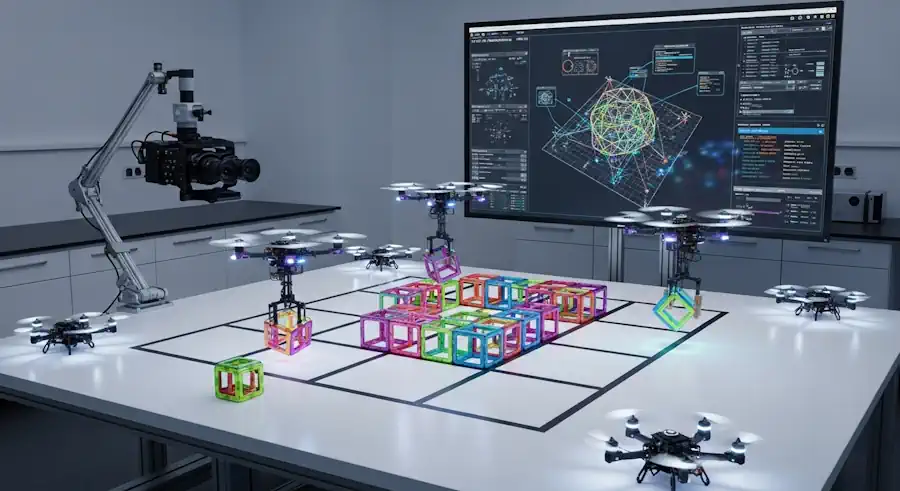
The qualitative testing was even more interesting. On a smaller 5×5 grid, the team gave the system open-ended design requests for simple geometric shapes like stars, trapezoids, and triangles. Human evaluators then judged whether the designs were both feasible (following all the rules) and recognizable (could a person identify the shape without being told what it was supposed to be?).
In physical tests monitored by cameras, the system achieved an impressive 90% success rate. When drones dropped blocks in wrong positions, left gaps, or built inefficiently, the closed feedback loop between the camera monitoring system and the LLM allowed for real-time corrections. The AI would analyze the mistake and generate a new plan that incorporated the error rather than requiring the entire structure to be rebuilt.
Importantly, the system had no mechanism to remove erroneously placed blocks; once a block was placed, it stayed. This constraint actually made the AI more robust, forcing it to be creative in working around mistakes rather than relying on do-overs.
Real-World Applications on the Horizon
So, where could we actually see these AI-guided construction drones in action? The possibilities are as exciting as they are practical.
Disaster relief is an obvious application. When earthquakes, floods, or other catastrophes destroy infrastructure, these drones could quickly build temporary shelters or repair critical structures while rescue teams focus on saving lives. In mountainous or remote regions where heavy machinery simply can’t operate, aerial additive manufacturing could enable construction projects that would otherwise be impossible or prohibitively expensive.
Urban maintenance is another promising area. Imagine drones autonomously patching potholes overnight or repairing hard-to-reach parts of buildings and bridges. Cities could maintain their infrastructure more efficiently and safely, without putting human workers at risk in dangerous locations.
Perhaps most ambitiously, Barati Farimani envisions these systems being used in space. “We can imagine this tool filling potholes, fixing spaceships in orbit, and constructing infrastructure in mountainous regions where heavy machinery can’t reach,” he said. In the vacuum of space, where sending human repair crews is extremely expensive and dangerous, autonomous construction drones could be game-changers for maintaining satellites, space stations, and future lunar or Martian habitats.
What Comes Next
The Carnegie Mellon team isn’t stopping with their current success. Moving forward, they plan to take their drones out of the controlled lab environment and test them in real-world conditions with all their unpredictable variables, wind, uneven terrain, and varying light conditions.

They’re also working on expanding the system’s capabilities in two key directions. First, they want to move beyond simple 2D patterns to full 3D structures, which will require even more sophisticated spatial planning from the AI. Second, they’re exploring more dynamic building materials that would give the system greater flexibility in what kinds of structures it can create and how it can optimize designs for different purposes.
The Future of Construction Is Taking Flight
This research represents a fundamental shift in how we think about construction and manufacturing. By combining the mobility of drones with the planning intelligence of AI and the precision of additive manufacturing, Carnegie Mellon has created a system that could literally reach places and solve problems that have been out of our grasp.
Whether it’s disaster relief, urban maintenance, remote construction, or even space exploration, AI-guided aerial additive manufacturing opens up possibilities that seemed like pure science fiction just a few years ago. As these systems continue to develop and move from lab to field testing, we might soon see the skies filled with tireless drone workers, building our future one magnetic block at a time.
